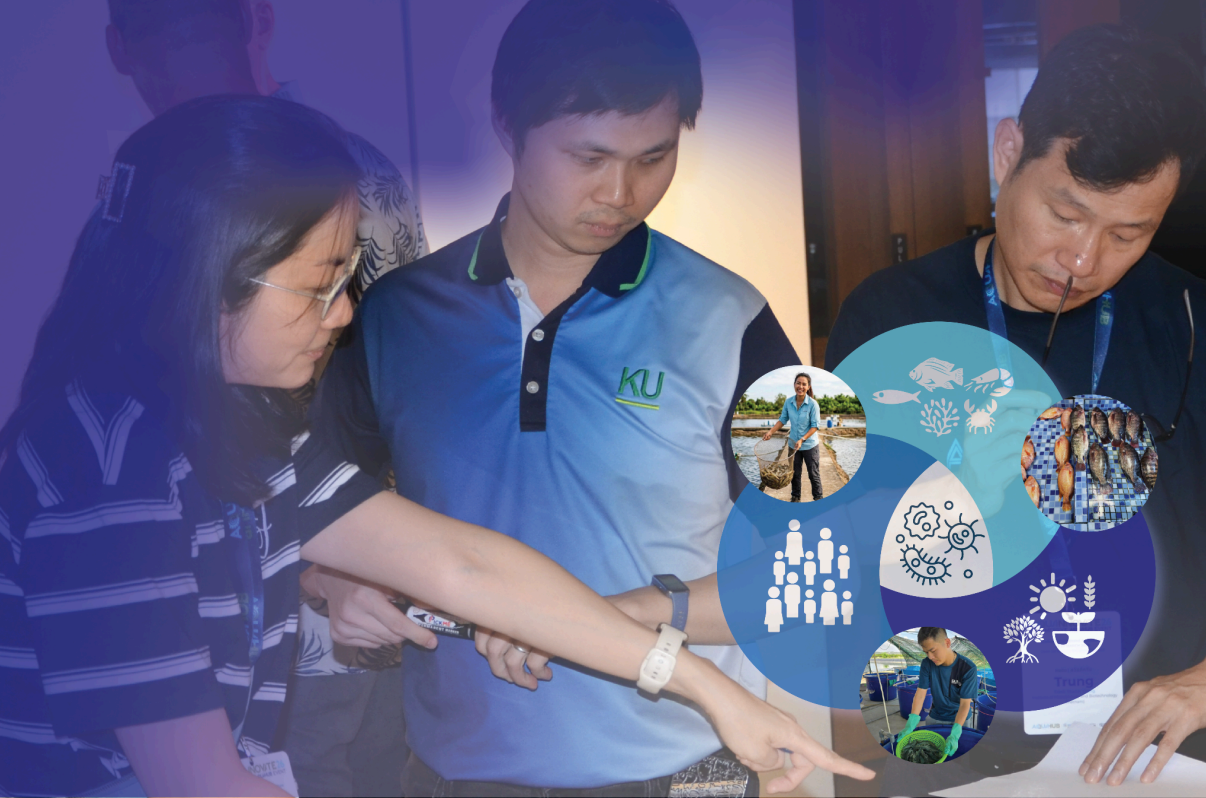
At the AQUAINNOVATE 2026 event, held in collaboration with InnoVet-AMR 2.0, we brought together researchers, policymakers, and investors to transform these scientific realities into farm-level success.
The Roadmap: An Action-Biased White Paper
Synthesised by FutureFish, this document builds upon the newly released White Paper, Policy Pathways for Antimicrobial Alternatives in Aquaculture, by the Network of Aquaculture Centres in Asia-Pacific.
Rather than a standard research report, this serves as a policy-shaping, "action-biased" roadmap. It is designed to transition the sector from a "vicious cycle" of antibiotic reliance to a "virtuous cycle" of sustainable health management. The White Paper proves that the primary challenge is no longer a lack of technical solutions but a failure of enabling systems.
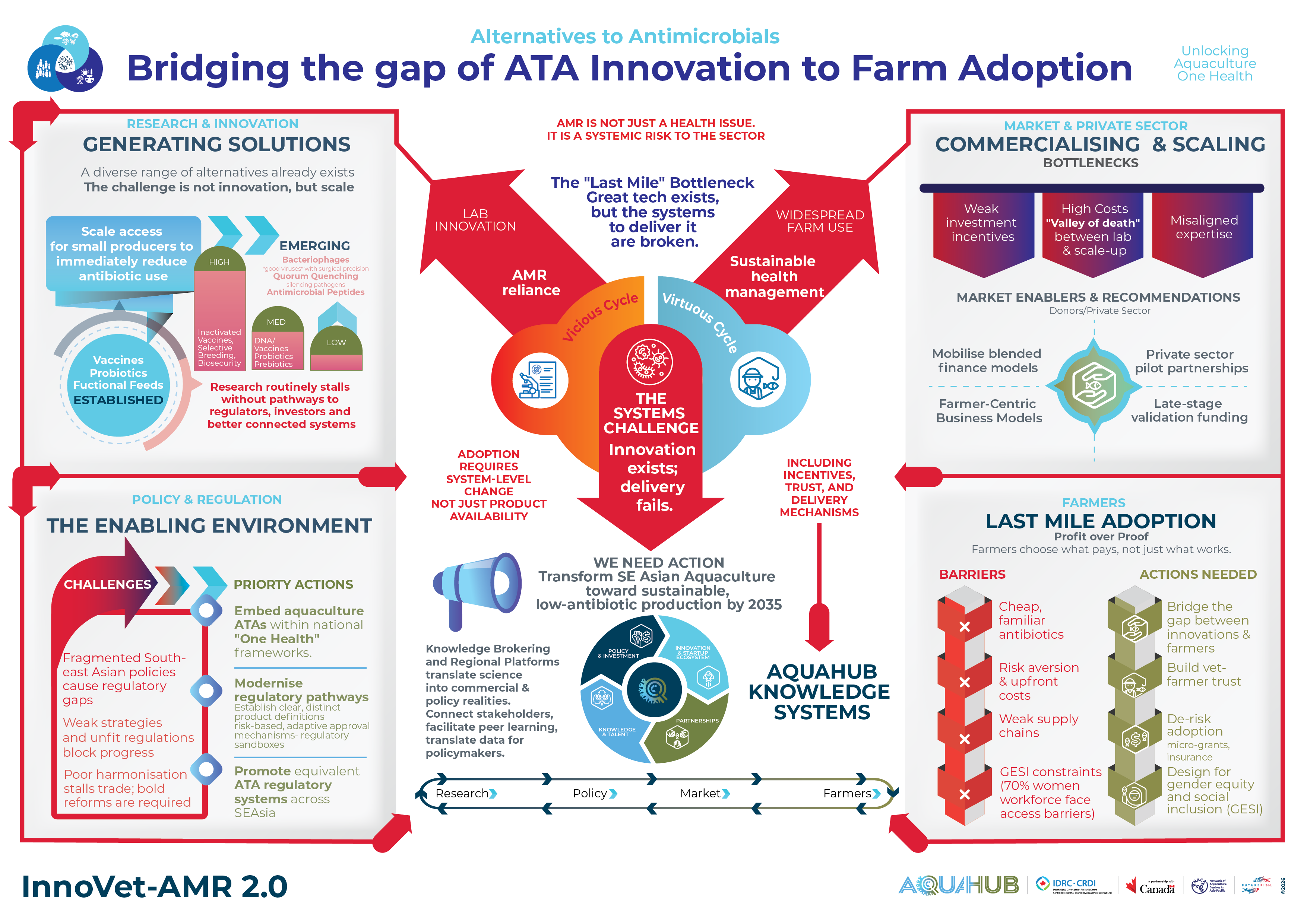
Bridging the Gap - The ATA Innovation to Farm Adoption infographic visualises the core systems challenge and the roadmap to sustainable scale
Key Messages for the Sector: A Focus on Policy Reform
To break the "vicious cycle" of AMR reliance, the sector must address critical systemic challenges:
- Innovation exists; delivery fails: The challenge is not a lack of solutions but a failure of enabling systems to scale access for small producers.
- Regulatory Limbo & Fragmentation: Fragmented South-East Asian policies cause regulatory gaps. Poor harmonisation stalls trade. Unclear product definitions—where a product might be classified as "feed" in one country and "medicine" in another—block progress.
- Modernise Regulatory Pathways: Bold reforms are required, including the establishment of distinct product definitions and adaptive approval mechanisms to overcome unfit regulations.
- Profit over Proof: For adoption to occur, farmers choose what pays, not just what works. Alternatives must be economically competitive with cheap, familiar antibiotics to overcome risk aversion and upfront costs.
AMR Innovation in Action: Three Stories of Transformation
During AQUAINNOVATE 2026, we sat down with three research teams leading the charge in developing ATAs to explore their technical readiness and scaling bottlenecks:
1. The TiLV Vaccine (Thailand)
Tuchakorn "Palm" Lertwanakarn is developing a needleless immersion vaccine targeting Tilapia Lake Virus (TiLV). While traditional antibiotics have only a 30% efficacy, this vaccine offers 70% protective efficacy. His vision for the sector is clear: "Our vision is 'Healthy Fish, Healthy People' by preventing disease before it starts". However, the regulatory path is slowed because the Thai FDA currently applies rigid human-grade standards to fish vaccines, and a lack of commercial antibodies prevents researchers from evaluating required immune responses.
2. Broad-spectrum Vibrio Vaccine (Thailand)
Represented by Warangkhana Songsungthong, the ShrimpGuard project utilises a highly specific bacteriophage cocktail. These phages offer "surgical precision", inhibiting bacterial growth by over 87% within 12 hours. Warangkhana explains, "We target only the bad bacteria to keep the shrimp's gut healthy." Despite robust technical results, the innovation is stalled in "regulatory limbo", with agencies conflicting on whether to classify it as a "veterinary drug" or a "hazardous substance".
3. Indigenous Probiotics (Vietnam)
Trinh Thanh Trung is pioneering an indigenous, lyophilised probiotic. With a 1,000x concentration boost ($1011 $ microbes/gram), 1g replaces 1kg of traditional product, slashing logistics costs. "Our technology cuts costs and shortens the shrimp cycle by 30%, helping farmers grow more with less," Trung stated. Yet, the project faces a "Valley of Death" scaling hurdle: transitioning from lab success to industrial-scale lyophilisation and navigating a 2+ year approval process for novel indigenous strains.
Summary: Translating Science into Success
These three projects demonstrate a powerful spectrum of solutions, but research routinely stalls without clear pathways to regulators and investors.
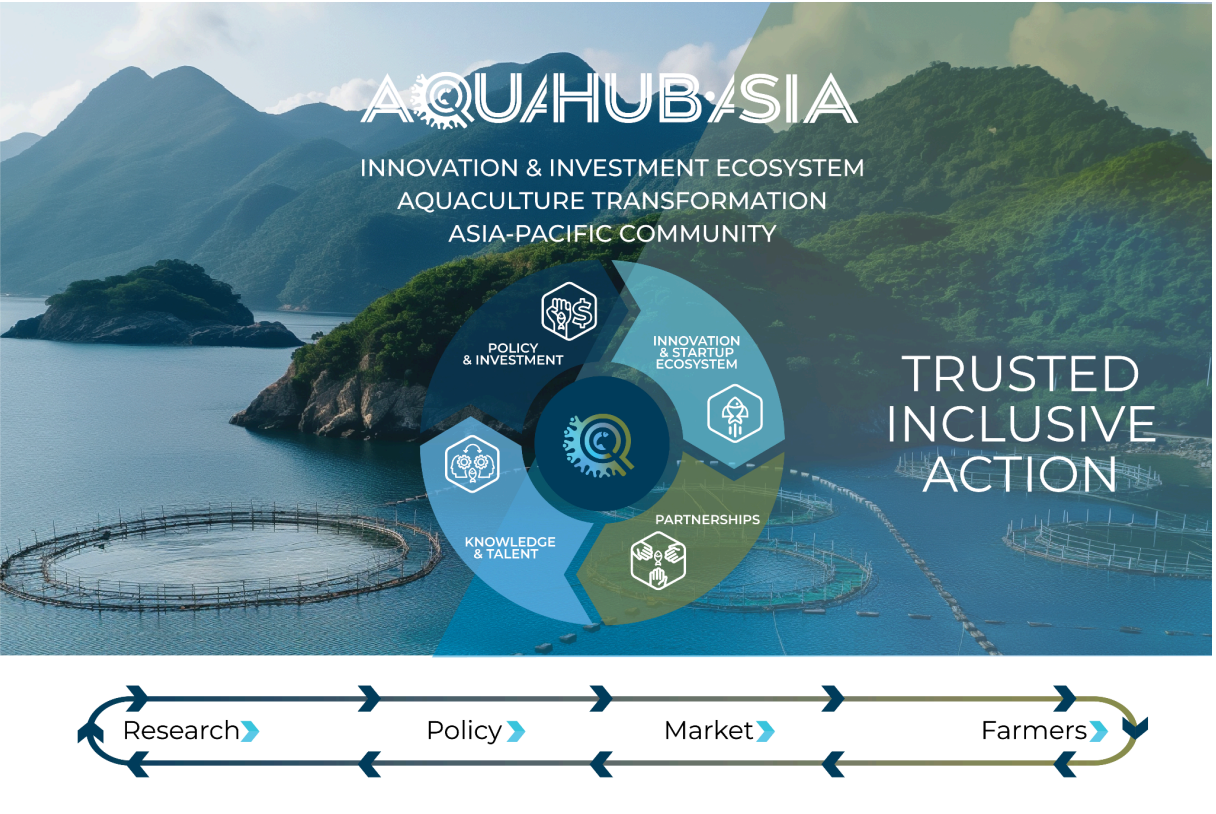
The AQUAHUB ecosystem approach advocates for a "Circular Flow" (Research > Policy > Market > Farmers > Repeat) to replace fragmented, one-off interventions. By acting as a neutral knowledge broker, AquaHub translates science into commercial and policy realities. This flow ensures that data from the lab informs policymakers to create enabling regulations, which in turn incentivises the private sector to bring products to market, ultimately building farmer trust.
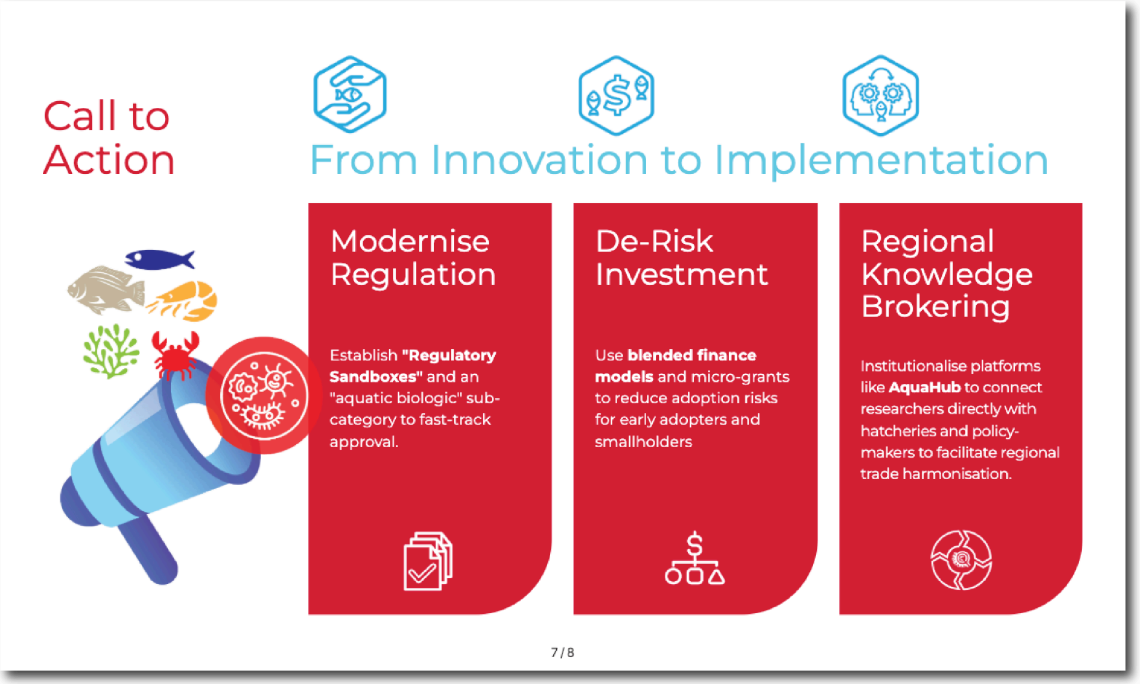
Call to Action: From Innovation to Implementation
The window for action is narrowing. To move from laboratory pilots to widespread farm use, this roadmap advocates for urgent, systemic reform. We call on the sector to:
Modernise Regulation: Establish "Regulatory Sandboxes" and an "aquatic biologic" sub-category to fast-track approval.
De-Risk Investment: Use blended finance models and micro-grants to reduce adoption risks for early adopters and smallholders.
Regional Knowledge Brokering: Institutionalise platforms like AquaHub to connect researchers directly with hatcheries and policymakers to facilitate regional trade harmonisation.
Join us in turning science into farm-level reality.
Connect with AquaHub.Asia today.
Log in to access our INNOVET Impact Case Studies and explore how antimicrobial alternatives (ATAs) can be scaled across Southeast Asian aquaculture.